
Considerations When Valuing Investment Holding Companies for Divorce Purposes
BY MARK W. NORRIS AND CONNOR J. THURMAN
The following article was prepared by its author(s). The opinions expressed in the article represent the author(s)’s and may not reflect the view and/or opinion of Vallit Advisors and its staff. Views/opinions are based on the specific facts and circumstances of each Matter.
Mark W. Norris, CPA/ABV, CVA, MAFF, ASA, is a co-founder and managing member of Vallit Advisors, LLC. Mr. Norris has over 42 years of accounting and business operations experience and has been providing business valuation consulting services for 28 years. He provides diverse litigation support services to the legal community including business valuations, expert testimony, economic loss calculations, and consulting on fraud detection and prevention.
Connor J. Thurman, ASA, ABV, is a Manager with Vallit Advisors, LLC. Mr. Thurman has over 7 years of experience in business valuation, tangible and intangible asset appraisal, and various other litigation services. He has written numerous articles in professional and peer-reviewed journals covering a variety of topics in his areas of expertise and has presented on these topics via webinars and conferences.
Vallit Viewpoints
In certain divorce legal proceedings, the valuation of a spouse-owned investment holding company may be required for purposes of the divorce settlement. In such instances, valuation analysts (“Analysts”) may be retained by legal counsel (“Counsel”) to determine the value of such an investment holding company. While the valuation of these companies may be determined by applying the income approach, market approach, or asset approach, the asset approach is commonly applied. This article discusses considerations that Analysts should make when valuing investment holding companies for divorce purposes, specifically when applying the asset approach.
Introduction
Analysts are often retained in divorce legal proceedings to provide expert witness services related to (among other things) the value of businesses that may be owned by one or both of the spouses in the divorce matter. In some circumstances, the value of such businesses may be significant, and thus, the value of the business to be added to the spouses’ marital balance sheet may be a contested issue.
For the purposes of Analysts, it is important to note that the laws surrounding divorce, particularly related to business valuations and marital asset division vary from state to state. A full discussion of the variation between states is beyond the scope of this article.
However, generally, the value of a business owned by one or both spouses is determined and that value is added to the marital balance sheet. The value of such a business is typically determined by Analysts that are retained by Counsel for each spouse, though some Analysts may be retained jointly or may be appointed by the Court. The ultimate value relied on by the Court for such a business may depend on the quality of each Analysts’ work.
The companies that may require valuation in these divorce matters may be broadly classified as either (1) operating companies or (2) holding companies. At a high-level, operating companies are businesses that operate in an “active” manner, often buying and selling products or services. Examples of operating companies are restaurants, retail stores, and manufacturing companies. Conversely, holding companies are business that engage in a “passive” manner, often holding valuable assets either for value appreciation, income generation, or both. Examples of holding companies are those that may own a portfolio of rental houses or a portfolio of venture capital (“VC”) or private equity (“PE”) investments. This article will focus on holding companies.
The next sections of this article will discuss common considerations when performing business valuations for divorce purposes and considerations when valuing investment (such as VC or PE investments) holding companies in such divorce matters.
Valuations for Divorce Purposes
As discussed above, business valuations may be required in divorce matters where one (or both) of the spouses hold ownership interests in companies. While a full discussion of the intricacies of business valuations for divorce purposes is beyond the scope of this article, below are some important considerations Analysts make when performing such valuations.
Standard and Premise of Value
The standard of value is an important consideration in all valuation assignments. For divorce purposes, the standard of value is often fair market value (or “FMV”),but ultimately depends on the standard of value adopted by the relevant legal jurisdiction. A common definition of FMV is:
the cash or cash equivalent price at which the property would change hands between a willing buyer and a willing seller; neither being under the compulsion to buy or to sell and both having reasonable knowledge of all relevant facts.
Another important consideration in all valuation assignments is the premise of value. Typical premises of value are (1) the going-concern premise and (2) the liquidation premise. The going-concern premise simply means that the valuation analysis is performed assuming that the subject company will continue to operate into the future as it has in the past, while the liquidation premise means that the valuation is performed assuming that the subject company (assets, etc.) will be sold (i.e., liquidated). Ultimately, the selected premise should reflect the premise that produces the highest value indication.
While not a universal fact, in reality, most business valuations in a divorce context tend to be performed under the going-concern premise of value. That being said, the Analyst should consider the fundamental position of the subject company and select the premise of value that produces the highest value indication.
Level of Value
Another important consideration is the appropriate level of value. The level of value is dependent on the nature of the ownership interest in the subject company that is being valued. Typically, the level of value consideration considers the following matrix:
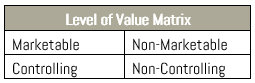
Marketability (either marketable or non-marketable) is often determined based on whether the subject company is publicly traded or privately owned. Often times in divorce matters, the subject company is a privately owned company as opposed to a publicly traded company. All else being equal, a private company is less “liquid” than a public company, meaning a “discount” (commonly known as the discount for lack of marketability or “DLOM”) to value is appropriate to recognize that it may be difficult (or impossible) to realize the cash-value of the ownership interest in the subject company.
The degree of control (either controlling or non-controlling) is often determined based on the degree of power that the subject ownership interest in the subject company possesses. For example, if the Analyst has been asked to value a 1 percent interest in a privately held company with two owners (one with 1 percent ownership and the other with 99 percent ownership), a “discount” (commonly known as the discount for lack of control or “DLOC”) to value is likely warranted because the 1 percent owner may have no control over how the company is operated.
A full and detailed discussion of valuation discounts and levels of value is beyond the scope of this discussion. However, it is a key consideration for Analysts to make in a valuation for divorce purposes.
Other Divorce Valuation Considerations
There are numerous other valuation considerations that Analysts make when performing valuations for divorce purposes. Some of these considerations may depend on the nature of the subject company or the subject ownership interest in that company. Other considerations may depend on the statutory or legal requirements in the particular jurisdiction that the divorce is subject to. For example, in some states, the valuation may be done as of the “date of separation,” or when the spouses are determined to have separated. In other states, the valuation may be done as of the “date of divorce,” or when the actual contemplated divorce is expected to be finalized. Because a valuation is a “snapshot” in time, the date of the valuation (i.e., the “Valuation Date”) can have a significant impact on the value conclusion.
The next section of this article focuses on considerations Analysts make when performing valuations of investment holding companies in divorce matters, specifically when applying the asset approach.
Investment Holding Company Valuation Considerations
In instances where one or both of divorcing spouses own an interest in an investment holding company, a business valuation may be required for the divorce proceedings. The following sections will discuss considerations related to the valuation of investment holding companies where (1) the asset approach, adjusted net asset value (“ANAV”) method is applied,1 (2) the underlying investments of the subject company are illiquid, and (3) the ownership interest in the subject company subject to valuation is a non-controlling interest.
Asset Approach Considerations
The asset approach is one the three generally accepted business valuation approaches, and it is regularly used when valuing holding companies. The asset approach is based built on the theory of substitution. The theory of substitution states that the maximum value of an asset is determined by the cost of acquiring an equally desirable substitute, meaning a buyer will not pay more for an asset than it would cost to obtain a comparable alternative with the same utility.
Said another way, when applied to holding company valuations, the asset approach contemplates the cost required to acquire a substitute portfolio of asset holdings (with the same utility) as the subject holding company’s assets.
For the purposes of this discussion, let’s assume that we have been retained by Counsel to value a 90 percent equity ownership interest (the “Interest”) in Alpha Holding Company, LLC (“Alpha”) as of December 31, 2024 (the “Valuation Date”) for divorce purposes. Let’s further assume that FMV is the appropriate standard of value and the going-concern premise has been applied. Furthermore, let’s assume that there are two owners of Alpha, our owner-spouse (“Spouse”) who owns 90 percent of Alpha equity and the owner-spouse’s friend (“Friend”) who owns the other 10 percent. Moreover, let’s assume that Alpha has an operating agreement that details the rights of Spouse and Friend in their ownership of Alpha. Finally, let’s assume that Friend is the “manager” of Alpha and possess materially all elements of control to manage Alpha as they see fit.
In our example, Alpha is an investment holding company with four assets, each being an investment in a different VC fund. As of the Valuation Date, Alpha had made cumulative capital contributions (i.e., had a capital account balance) of $1.3 million. Further, Alpha had received some distributions from the VC funds. See Figure 1 below.
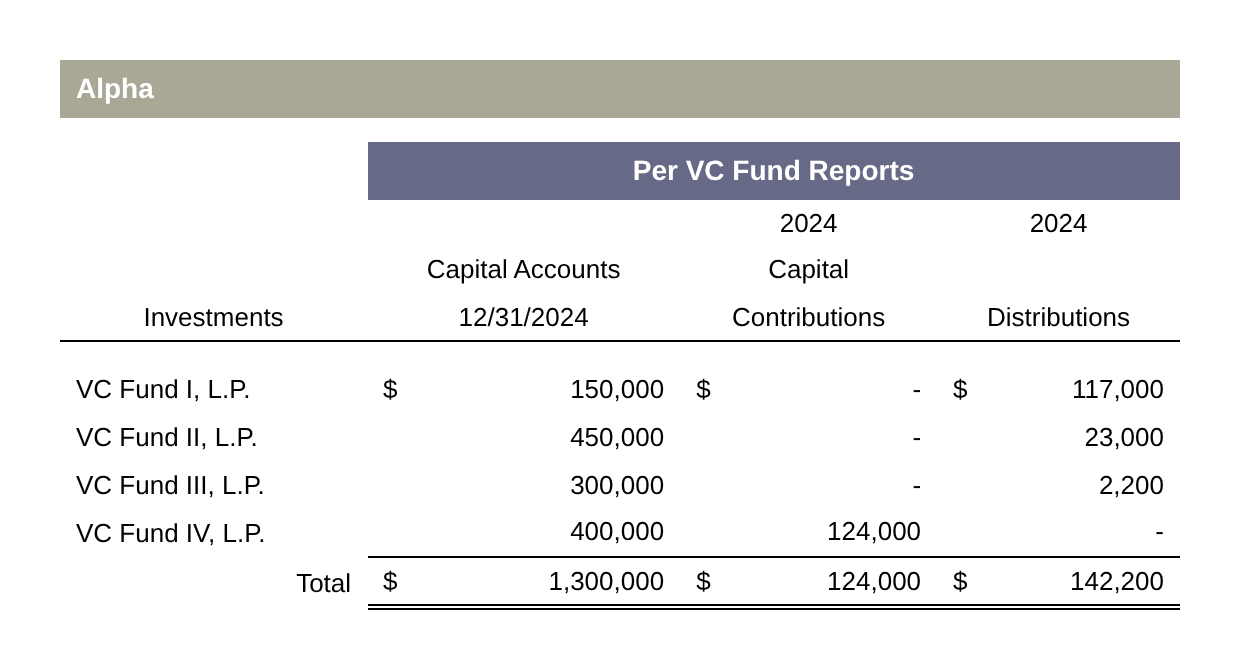
Based on Figure 1, the asset value (on an accounting book basis) would be $1.3 million, which would equal the capital contributed to date as the asset, with the total equity of Alpha also equaling the $1.3 million capital account amount. No liabilities are reported on an accounting book basis.
However, in this example, our assignment is to determine the FMV of the Interest in Alpha, which includes considering adjustments, such as off-balance sheet liabilities.
Fair Market Value Adjustments—Recording Built-In Capital Gains Tax Liabilities
Let’s assume that the VC funds in which Alpha is invested report significant unrealized gains on the value of the underlying VC investments. In such an instance, capital gains taxes will be incurred when those gains are realized. Therefore, despite not being booked on Alpha’s balance sheet, there is a built-in tax liability related to the capital gains / (losses) for investments held in the VC funds. Therefore, an adjustment in the ANAV Method is warranted for this tax liability.
Many VC funds (including the ones in our example) produce quarterly or annual reports that detail the financial performance of the VC fund. These reports often include details related to (1) the nature of the underlying investments, (2) the realized and unrealized gains or losses of the investments, (3) any income or distributions related to the investments, (4) any expenses or costs related to the investments, (5) performance (e.g., internal rates of return or “IRR” of the investments, etc.), and more.
In our example, we considered such VC fund reports as well as discussions with Friend to determine the level of any built-in capital gains tax liability. See Figure 2 below.
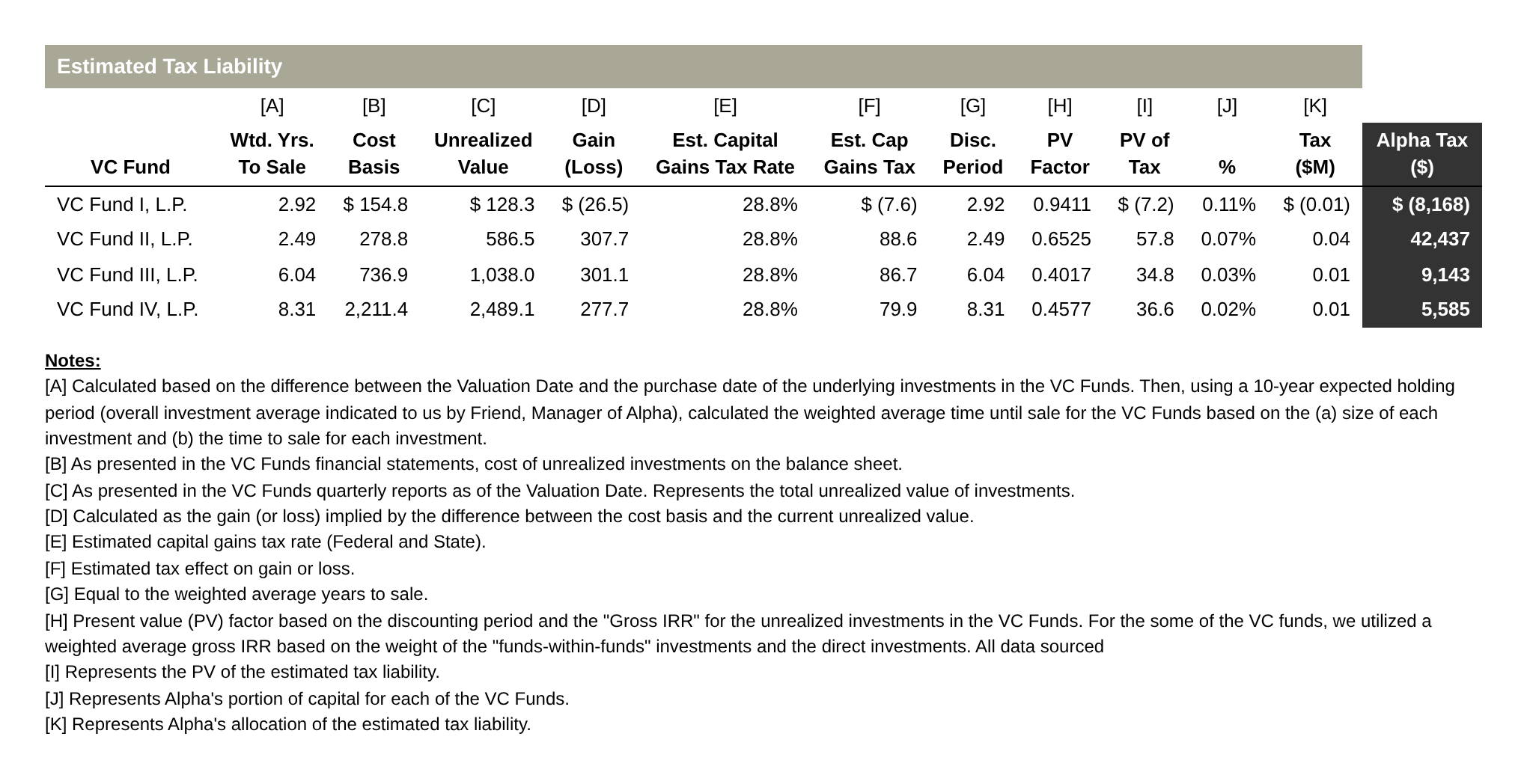
As presented in Figure 2, we analyzed the estimated time to sale of the VC funds as well as fundamental investment characteristics such as the cost basis of the VC funds, unrealized value of the VC funds, estimated tax rates and more to estimate the built-in tax liability. This estimated present value of the tax liability will be added as an adjustment in the ANAV Method analysis.
Fair Market Value Adjustments—Applying Investment-Level Discounts
As discussed previously, discounts are an integral part of the FMV analysis. In the case of investment holding companies like Alpha that hold illiquid VC fund investments, a DLOM is often warranted on the individual investments.
It should be noted that an argument may be made that not only should a DLOM be applied to the VC funds, but a further DLOM should be applied to the underlying holdings of the VC funds. For example, see Figure 3 below that provides an example of the holdings of Alpha.
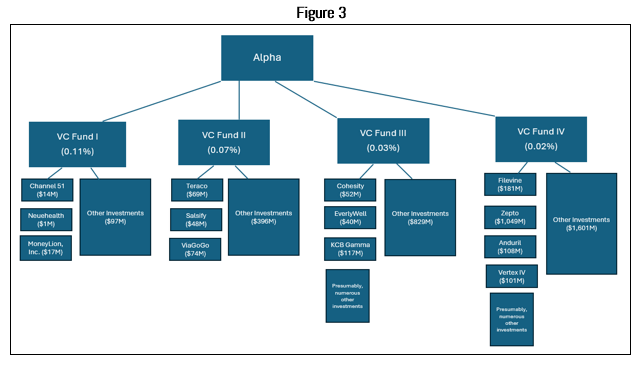
As presented in Figure 3, the VC Funds own interests in both public and private companies, as well as (in some circumstances) interests in more VC funds. Each of these investments represent “layers” of illiquidity. For example, Alpha owns 0.02 percent of VC Fund IV which, in turn, owns an interest in Anduril (a private U.S. defense contractor) as well as an interest in “Vertex IV” (another VC fund), among other investments. Presumably, the Vertex IV fund owns other interests in companies and, perhaps, interests in yet more VC funds.
All else being equal, Alpha’s ownership interest in Anduril (via its ownership interest in VC Fund IV) is more liquid than its ownership interest in the underlying investments in the Vertex IV fund.
However, for the purposes of our example, let’s limit our investment-level DLOM adjustment to just the VC funds level. That is, we’ll apply one DLOM.
While a full discussion of the factors considered in an investment-level DLOM analysis is beyond the scope of this article, let’s assume that we considered (1) the level of distributions that Alpha received from the VC funds (all else being equal, investments that distribute cash to owners have lower discounts than ones that do not), (2) VC industry reports that provide indications of discounts on VC investments such as Lazard and Jeffries reports, and (3) other DLOM market data from sources such as closed-end fund data from Partnership Profiles.
Based on our analysis of the data discussed above, we determined that a 20 percent investment-level DLOM was appropriate for the Alpha investments in the VC funds.
After applying the investment-level DLOM and tax liabilities adjustments, Figure 4 below details the results of our ANAV Method analysis.
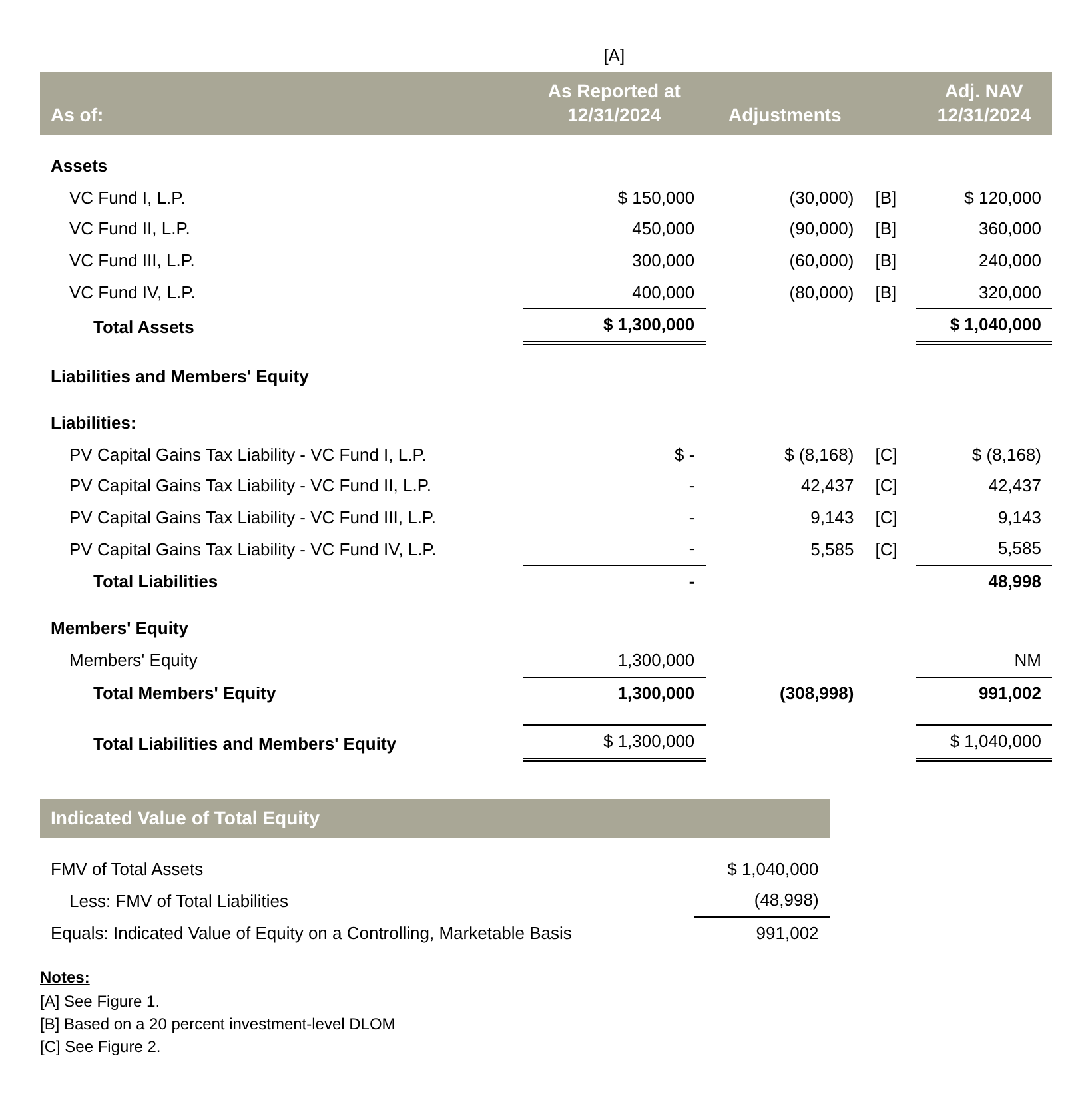
As presented in Figure 4, by properly applying the three adjustments discussed, the FMV (before entity-level discounts) of Alpha equity is decreased from $1.3 million to $991.0 thousand. However, as we discussed earlier, we are valuing Spouse’s 90 percent interest in Alpha. As such, an entity-level DLOC and entity-level DLOM must be considered.
Fair Market Value Adjustments—Applying Entity-Level Discounts
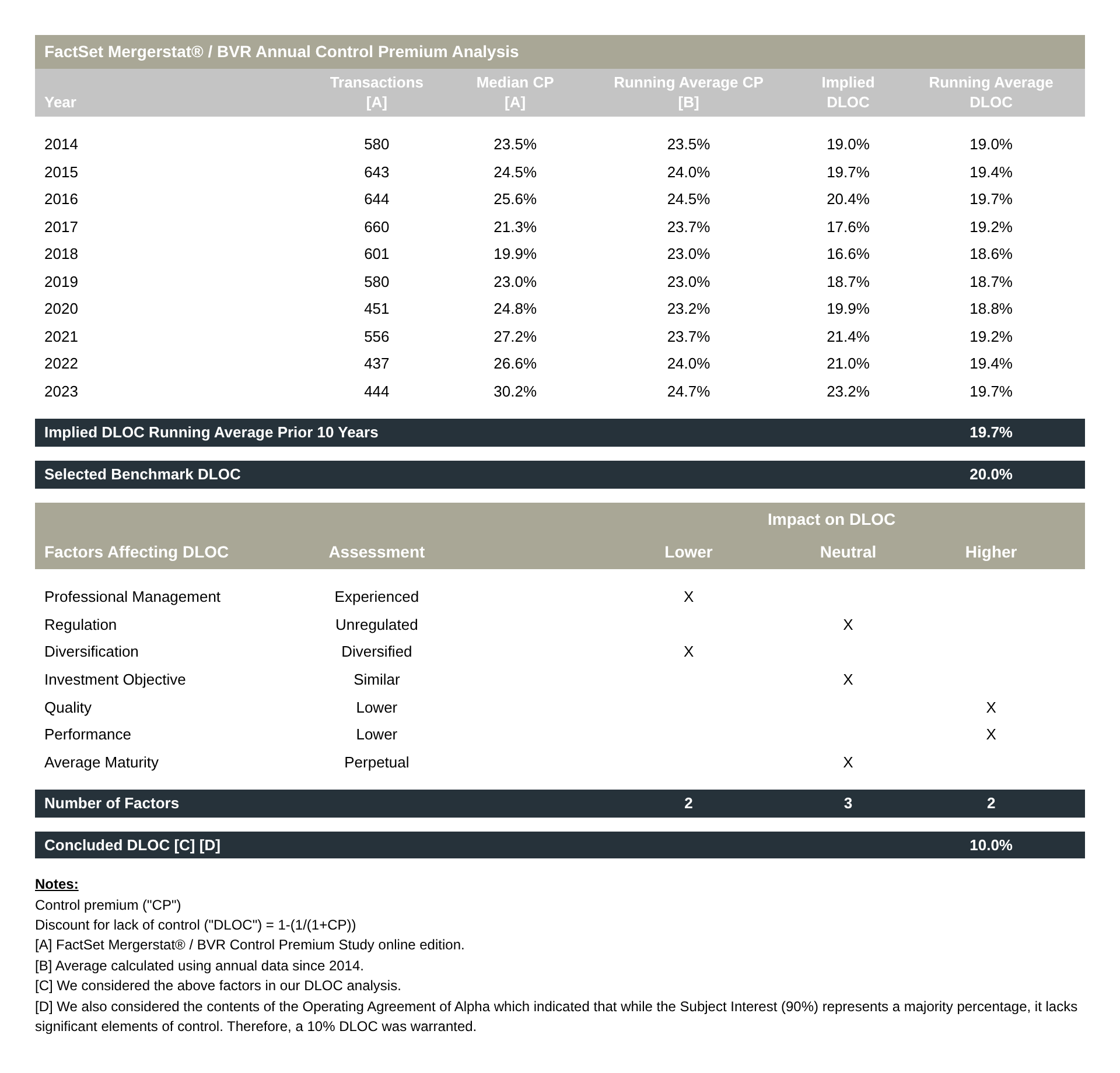
First, we consider whether an entity-level DLOC should be applied to Spouse’s 90 percent interest in Alpha. In most cases, 90 percent of a company’s equity represents a controlling interest and no DLOC would be applied. However, in our example, Friend is the managing manager of Alpha and possesses materially all elements of control to manage Alpha as they see fit. Therefore, we considered (1) third-party market data on control premiums from sources such as FactSet Mergerstat or BVR’s Control Premium Study, (2) a quantitative factor analysis of Alpha, and (3) the terms within Alpha’s operating agreement to determine if a DLOC was warranted for the Interest.
As presented below in Figure 5, we determined a 10 percent DLOC was warranted.
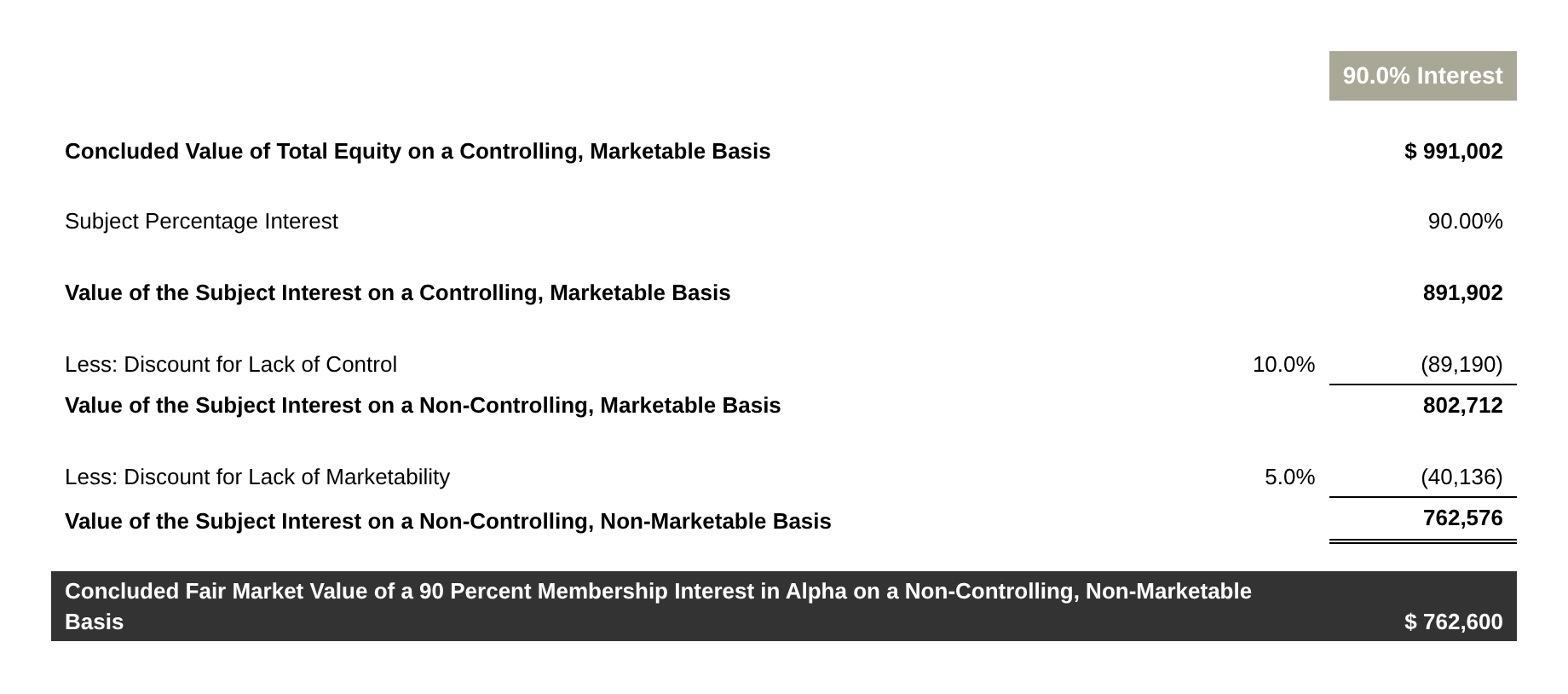
Finally, based on the cumulative discounts from the investment-level DLOM and the entity-level DLOC analyses, as well as consideration of factors such as the ability of Spouse to sell their interest in Alpha or the level of historical Alpha distributions to Spouse and Friend, we determined a 5 percent entity-level DLOM was warranted. Figure 6 below presents the results of these adjustments being applied and the concluded FMV of the Interest.
Fair Market Value Adjustments—Other Potential Adjustments
Other adjustments that may be made in an asset approach analysis of an investment holding company might include adjustments for (1) discount for lack of voting rights, (2) other off balance sheet assets such as valuable contracts, (3) other off balance sheet liabilities such as contingent liabilities (say, potential lawsuit costs), and other adjustments.
Ultimately, the Analyst must gain a detailed understanding of the subject company and the valuation purpose to determine what, if any, other adjustments should be made.
Summary and Conclusion
This article discussed considerations that Analysts should make when valuing investment holding companies for divorce purposes. Specifically, this article addressed various adjustments that are often appropriate when applying the asset approach to value such companies. This article also summarized important considerations for Analysts to make when performing valuations in divorce matters.
1 A full discussion of the income approach, market approach, and asset approach is beyond the scope of this article. Rather, this article will focus on important considerations of the asset approach analysis.
The contents above are purely educational in nature. The information contained within the website of Vallit Advisors, LLC should not be assumed to be representative of the views and opinions held by Vallit Advisors, LLC. Information found on this website is not intended to be legal advice, it is not intended to create or solicit instructions of any kind and should not be treated as such. By accessing this web site, you are agreeing to be bound by the web site Terms and Conditions of Use.
Providing a Clear View of The Financial Picture
Vallit is focused solely on dispute consulting, business valuation and forensic accounting. Our senior team members have testified approximately 400 times in Federal, State and International courts. Our dispute expertise ranges from family law to complex commercial and intellectual property matters in a wide variety of industries. In non-disputes, our valuation reports are relied on by estate and trust attorneys, auditors, and business decision makers for tax, financial reporting and transaction purposes.